The Science of Tajweed: Why Your Recitation Changes the Meaning
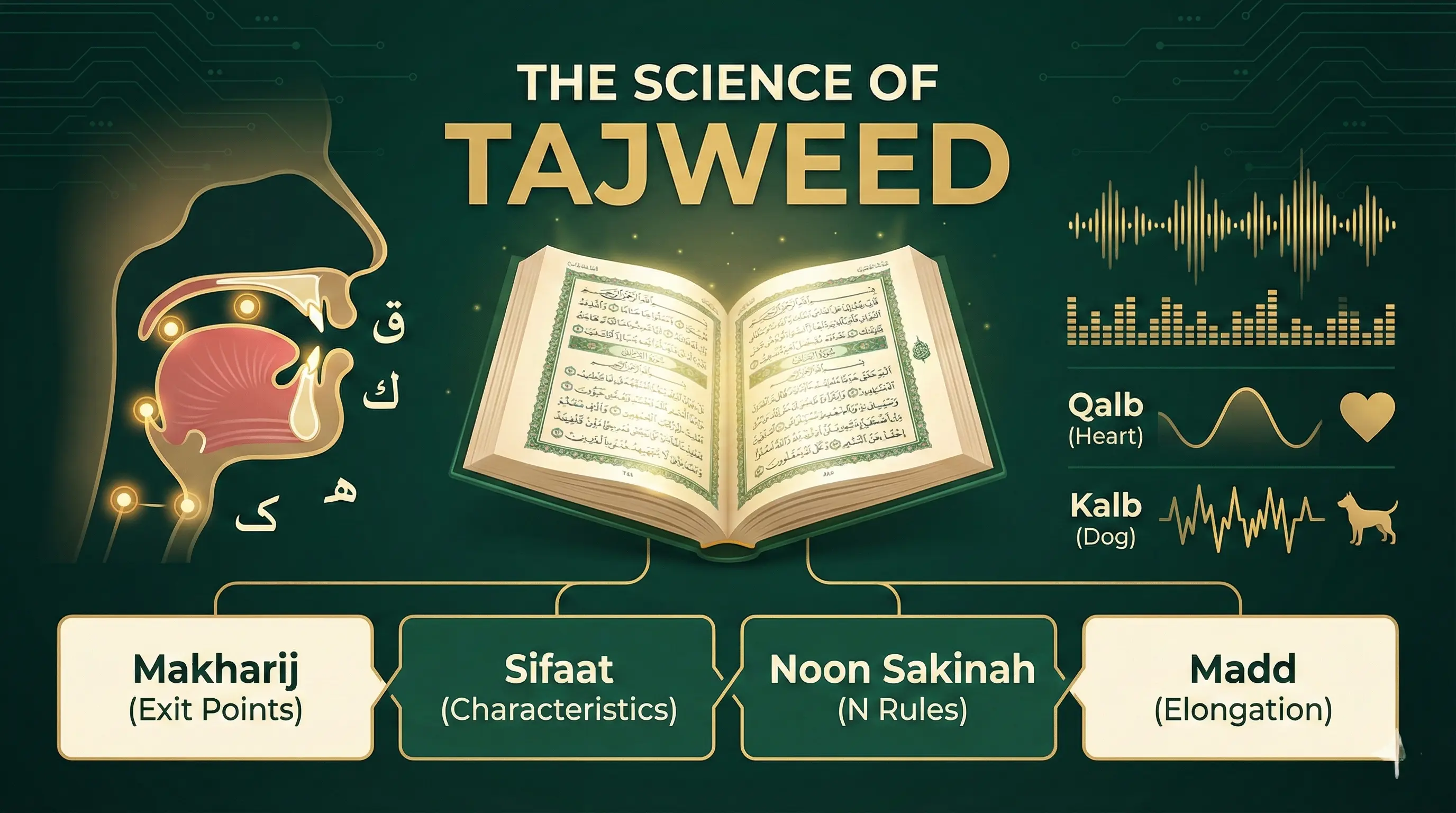
Many students recite the Qur’an sincerely, yet a small pronunciation mistake can completely change the meaning—Qalb (heart) turning into Kalb (dog) is a well-known example. This is not a minor error; it transforms sacred words into something unintended. Understanding Tajweed is not about sounding beautiful—it is about preserving the meaning, respect, and message of Allah’s words.
What is Tajweed?
Tajweed is the discipline of reciting the Qur’an correctly by pronouncing each letter from its proper place (Makhraj) and giving it its full sound rights.
🎧 The Sound Lab: Qalb vs. Kalb
✅ Qalb (Heart)
Letter: Qaf (ق)
Heavy sound from throat❌ Kalb (Dog)
Letter: Kaf (ك)
Light sound from mouthThe 4 Pillars of Tajweed
1. Makharij ↗
The exact exit points in the mouth and throat from where each Arabic letter is pronounced.
2. Sifaat ↗
The natural characteristics of letters, such as softness, heaviness, breathiness, or strength.
3. Noon Sakinah ↗
The rules that govern how the 'N' sound is pronounced, merged, hidden, or made clear.
4. Madd ↗
The science of stretching certain vowel sounds for a specific and fixed duration.
“Applying Tajweed is an obligation, and whoever does not recite the Qur’an with Tajweed is sinful.”— Imam Ibn al-Jazari (رحمه الله)
Common Questions
Yes, learning basic Tajweed is obligatory to avoid changing the meanings of Qur’anic words.
Yes, Tajweed focuses on pronunciation and sound, not Arabic grammar or vocabulary.
With consistent practice, basic Tajweed can be learned within a few months.